Chicken Supreme often gets lost in the shuffle of fancy dishes, but I find its quiet charm in simple, honest ingredients. It’s the kind of meal that feels like a warm hug after a long day, yet can be elevated with just a few careful touches. That balance between comfort and a touch of elegance keeps me coming back to it, especially when I need something familiar but still special.
This dish is about embracing the humble chicken breast—something I used to overlook as too plain—then giving it a chance to shine. It’s about the magic that happens when you cook it right, letting the natural juices stay intact and adding just enough seasoning to make every bite memorable. It’s a reminder that even the simplest ingredients, treated with care, can become something worth savoring.
Focusing on the overlooked charm of a humble, classic dish elevated with simple, honest ingredients—showing that comfort food can be both nostalgic and surprisingly refined.
Reviving the Classic Chicken Supreme
- I love how a simple chicken breast can turn silky and juicy with just the right touch of cream and wine.
- There’s a nostalgic rush when I remember family dinners, the aroma filling the house, everyone gathered around the table.
- Sometimes I chaos-throw this together last minute, yet it still feels fancy enough for guests or a special treat.
- Getting the sauce just right, thick and velvety, feels like a small triumph every single time.
- It’s a dish that reminds me to savor the slow, careful steps — that’s where the magic really happens.
Reviving the Classic Chicken Supreme
Chicken Supreme has a way of sneaking into my kitchen whenever I need a bit of comfort that doesn’t feel overly complicated. I remember one winter evening, I was feeling worn out after a long day, and all I wanted was something rich but simple. The way the sauce coats the chicken, creamy and just the right amount of savory, always makes me pause and appreciate the humble ingredients. It’s a reminder that elegance can be built from the most straightforward elements, if you treat them with a little patience and care.
Historical & Cultural Tidbits
- Chicken Supreme gained popularity in mid-20th-century European cuisine, particularly in France, as a luxurious yet accessible dish.
- The dish’s name hints at a regal presentation, but it traditionally originated as a humble way to elevate simple chicken with rich sauces.
- Historically, variations of this dish appeared in classic French cookbooks, often featuring a creamy mushroom or wine sauce.
- Despite its fancy-sounding name, Chicken Supreme was originally a home-cooked comfort meal, not a restaurant-only special.
Ingredient breakdown: key components
- Chicken breast: I prefer skinless, boneless breasts—they cook evenly and stay moist, but ensure you don’t overcook; a juicy, tender bite is the goal.
- Heavy cream: I love how it turns the sauce into a velvety richness that coats every bite—if you want a lighter version, swap half with milk, but it won’t be quite as luscious.
- White wine: The bright acidity lifts the sauce—use a decent dry white, like Sauvignon Blanc or Pinot Grigio; skip the fancy stuff unless you’re feeling indulgent.
- Mushrooms: Sautéed until golden and fragrant, they add earthy depth—if you’re short on time, toss in some canned mushrooms, but fresh really shine.
- Butter: Adds richness and helps build flavor—don’t skimp here, but if you’re dairy-free, a good quality olive oil can work in a pinch.
- Seasonings: Salt, pepper, and a touch of nutmeg—these simple spices enhance the dish without overwhelming, so taste as you go to get it just right.
- Parsley: Fresh chopped parsley at the end adds a burst of freshness—if you don’t have fresh, a sprinkle of dried can add some color, but fresh is better.
Spotlight on key ingredients
Chicken breast:
- I prefer skinless, boneless breasts—they cook evenly and stay moist, but ensure you don’t overcook; a juicy, tender bite is the goal.
- Heavy cream: I love how it turns the sauce into a velvety richness that coats every bite—if you want a lighter version, swap half with milk, but it won’t be quite as luscious.
- White wine: The bright acidity lifts the sauce—use a decent dry white, like Sauvignon Blanc or Pinot Grigio; skip the fancy stuff unless you’re feeling indulgent.
Mushrooms:
- Sautéed until golden and fragrant, they add earthy depth—if you’re short on time, toss in some canned mushrooms, but fresh really shine.
- Butter: Adds richness and helps build flavor—don’t skimp here, but if you’re dairy-free, a good quality olive oil can work in a pinch.
Notes for ingredient swaps
- Dairy-Free: Swap heavy cream for coconut cream or cashew cream—still rich, but with a different, subtly sweet coconut or nutty flavor.
- Wine Alternative: Use chicken broth or white grape juice instead of wine—adds moisture and a touch of acidity without alcohol.
- Mushrooms: Use sautéed zucchini or eggplant slices—will add moisture and umami without the earthy depth of fresh mushrooms.
- Herbs: Replace parsley with thyme or tarragon—each offers a unique aroma, with thyme adding earthiness and tarragon a slight licorice note.
- Butter: Substitute with olive oil or a dairy-free margarine—keep the richness, but note the flavor will shift slightly toward fruitiness or neutrality.
Equipment & Tools
- Large skillet (cast iron preferred): For even heat and browning
- Tongs: To flip and handle the chicken
- Spoon: For basting and serving sauce
- Sharp knife: For prepping ingredients
- Thermometer: To check chicken doneness
Step-by-step guide to Chicken Supreme
- Equipment & Tools: Use a large skillet (preferably cast iron) for even heat; tongs for flipping; a spoon for basting; a sharp knife for prep; a thermometer to check doneness.
- Prep the chicken: Pat breasts dry, season generously with salt and pepper, and set aside.
- Sear the chicken: Heat 2 tbsp of oil over medium-high (about 200°C/390°F). When shimmering, add chicken, skin-side down if skin-on, and cook until golden, about 4-5 mins per side. If skin-on, ensure crispness before flipping.
- Remove chicken: Transfer to a plate and cover loosely with foil. Keep warm.
- Make the sauce base: In the same skillet, add sliced mushrooms and cook until golden, about 5 mins. Add 2 minced garlic cloves; cook until fragrant, about 30 seconds.
- Deglaze: Pour in ½ cup white wine (like Sauvignon Blanc). Scrape up browned bits, cook until reduced by half (about 3 mins).
- Add cream: Stir in ¾ cup heavy cream, simmer gently until slightly thickened, about 4 mins. Season with salt, pepper, and a pinch of nutmeg.
- Return chicken: Nestle the breasts into the sauce, spoon some over, and cook on low for 5 mins until heated through. Check that internal temp reaches 75°C/165°F.
- Rest & plate: Remove from heat, let rest for 3 mins. Plate chicken, spoon sauce and mushrooms over, garnish with chopped parsley.
- Check doneness: The sauce should be velvety, chicken juicy, and sauce bubbling gently. The chicken should be cooked through with no pink.
- Serve immediately, pairing with buttery potatoes or crusty bread if desired.
Let the chicken rest for 3 minutes off heat, then serve with sauce spooned over. Garnish with fresh parsley for brightness.
How to Know It’s Done
- Chicken reaches an internal temperature of 75°C/165°F.
- Sauce is velvety and coats the back of a spoon.
- Chicken is juicy, not dry, with a slight jiggle in the center.
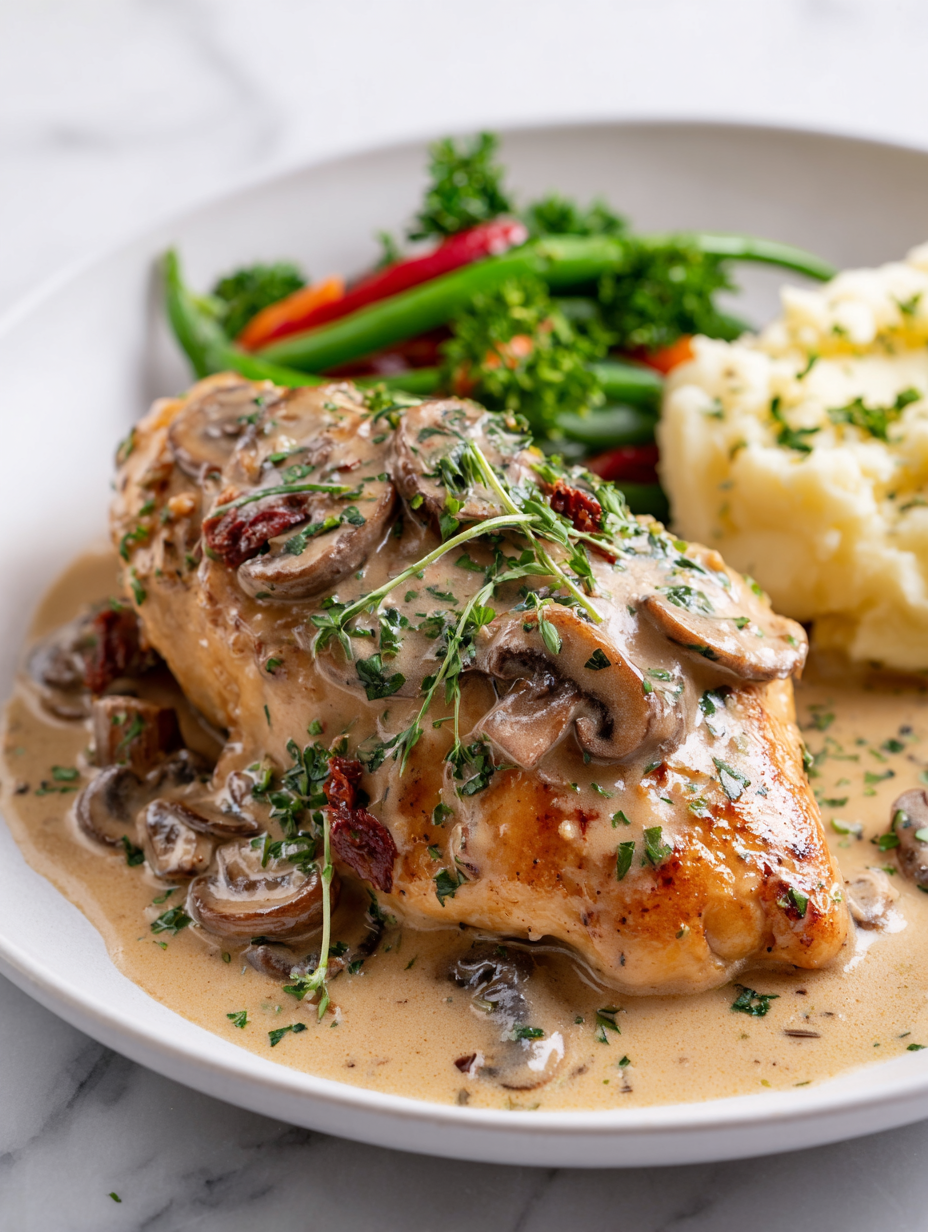
Classic Chicken Supreme
Ingredients
Equipment
Method
- Start by patting the chicken breasts dry and seasoning them generously with salt and pepper. Heat oil in a large skillet over medium-high heat until shimmering, then add the chicken. Sear for about 4-5 minutes on each side until golden brown and cooked through, then transfer to a plate and cover loosely with foil to keep warm.
- In the same skillet, add sliced mushrooms and cook until they turn golden and fragrant, about 5 minutes. Then, add the minced garlic and cook for another 30 seconds until aromatic.
- Pour in the white wine, scraping up the browned bits from the bottom of the pan, and simmer until the wine reduces by half, about 3 minutes. This builds depth in the sauce.
- Stir in the heavy cream and add a pinch of freshly grated nutmeg. Bring the mixture to a gentle simmer, stirring constantly, until the sauce thickens slightly and becomes velvety, about 4 minutes.
- Return the chicken breasts to the skillet, nestling them into the sauce. Spoon some sauce over the top and cook on low heat for another 5 minutes until heated through. Check that the internal temperature reaches 75°C (165°F) with a thermometer.
- Remove the skillet from heat and let the chicken rest for about 3 minutes. This helps to lock in the juices, keeping the chicken tender and moist.
- Garnish with chopped fresh parsley and spoon the luscious sauce and mushrooms over the chicken. Serve immediately with your favorite sides, such as buttery potatoes or crusty bread.
Pro tips for perfect Chicken Supreme
- Sear for color: Ensure the skillet is hot enough (around 200°C/390°F) before adding chicken to achieve a golden crust without sticking.
- Baste for juiciness: Tilt the pan slightly and spoon the hot sauce over the chicken during cooking for extra moisture and flavor.
- Deglaze properly: Use a good splash of wine and scrape up the browned bits—these add depth to your sauce, don’t skip it.
- Cream at the end: Add the heavy cream after deglazing, simmer gently, and stir constantly to keep the sauce velvety and prevent curdling.
- Rest before slicing: Let the chicken sit for 3 minutes after cooking—this keeps juices locked in for a tender bite.
- Taste and adjust: Always taste the sauce before serving; a pinch more salt or a squeeze of lemon can brighten it instantly.
- Use fresh herbs: Finish with chopped parsley or tarragon—bright, fresh herbs lift the rich sauce and add aroma.
Common mistakes and how to fix them
- FORGOT to check chicken temperature → Use a thermometer to avoid overcooking.
- DUMPED all the wine at once → Deglaze gradually, scraping up browned bits for flavor.
- OVER-TORCHED the sauce → Lower heat once cream is added, stir constantly to prevent curdling.
- SKIPPED resting the chicken → Rest for 3 minutes to keep juices in before slicing.
Fast fixes for Chicken Supreme
- When sauce looks grainy, splash in a teaspoon of lemon juice to brighten and smooth.
- If sauce is too thin, simmer a few minutes longer until it thickens with a glossy sheen.
- Splash a bit of water or broth if the sauce becomes too salty or concentrated.
- Patch over overcooked chicken with a quick brush of melted butter and fresh herbs.
- Shield burnt pan bits with a splash of cold water, then scrub gently to clean.
Prep, store, and reheat tips
- Prepping the chicken: Season and sear the breasts ahead, then refrigerate for up to 24 hours; the aroma of seasoned chicken will boost flavor.
- Sauce preparation: Make the mushroom and wine base a day before; reheat gently on low heat, stirring occasionally until warmed and fragrant.
- Storage life: Both cooked chicken and sauce keep well in airtight containers for 1-2 days in the fridge, maintaining their richness and aroma.
- Reheating: Gently warm in a skillet over low heat; the sauce will thicken slightly, so add a splash of water or broth to loosen it up, and smell that familiar, cozy aroma again.
Top questions about Chicken Supreme
1. Can I use chicken thighs instead?
Use skinless, boneless chicken breasts for even cooking and juiciness. They absorb flavors well and stay tender if not overcooked.
2. Can I substitute turkey for chicken?
Yes, but thighs are darker and juicier, so adjust cooking time to prevent drying out. They also add a richer flavor.
3. How do I prevent the sauce from curdling?
Absolutely. Turkey breasts work well and will give a similar texture, just watch the cooking time so it doesn’t dry out.
4. What if the sauce gets lumpy?
Add the cream slowly over low heat, stirring constantly. Keep the heat gentle and avoid boiling vigorously once the cream is in.
5. Can I make this dairy-free?
Ensure the skillet isn’t too hot when adding cream. If lumps form, whisk in a little warm milk or broth to smooth it out.
6. How do I keep chicken moist?
Yes, swap heavy cream for coconut cream or cashew cream. The sauce will be slightly different in flavor but still rich and tasty.
7. What’s the best way to check if chicken is done?
Cook chicken just until it reaches 75°C (165°F), then let it rest for 3 minutes. Resting keeps juices in for a tender bite.
8. How long should I simmer the sauce?
Use a meat thermometer inserted into the thickest part of the breast. It should read 75°C (165°F).
9. Can I prepare this ahead of time?
Simmer the sauce until it thickens enough to coat the back of a spoon, about 4-5 minutes after adding cream.
10. How do I reheat leftovers without losing texture?
Yes, you can sear the chicken and prepare the sauce a day ahead. Reheat gently, stirring to bring back the richness.
Cooking chicken supreme feels like a quiet act of care—slowly developing flavor and texture that reward patience. It’s a dish that grounds me, a reminder that simple ingredients, treated well, can still surprise and comfort. Right now, it’s about leaning into those familiar, honest flavors that soothe amid chaos.
In the end, it’s not just about the sauce or the chicken but the small moments of attention—browning, simmering, resting—that make the meal memorable. A dish like this reminds me that sometimes, the best comfort comes from the simplest, most honest cooking.

Hi, I’m Emily Carter, the founder of Absolute Chaos Mode. Born and raised in Portland, Oregon, I grew up in a household where dinner was equal parts delicious and unpredictable